1. It’s and It Is

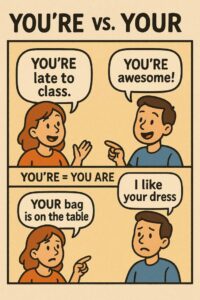
3. You’re and Your
We’ve all been there. You’re typing fast, feeling confident, and then… bam! — someone points out that you mixed up “you’re” and “your.” Instant embarrassment. Don’t worry, you’re not alone.
You’re” is simply the short form of “you are.” If you can replace the word with “you are” and the sentence still makes sense, then you’re is the right choice. For example: You’re late to class or You’re an amazing singer. On the other hand, “your” shows ownership—it’s used when something belongs to you.
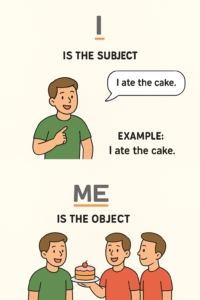
3. Me vs. I
This is another mistake people make very often. Both are pronouns, but they play different roles in a sentence.
I is the subject- the one doing the action.
Example: I went to the market.
Me is the object- the one receiving the action.
Example: He gave me a gift.
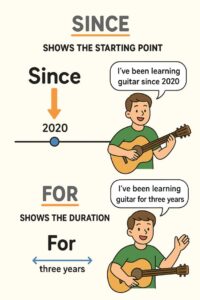
4. Since vs. For
Many learners get confused between since and for, but the rule is actually very simple. We use since to talk about the starting point of an action—the exact time when something began. For example: I’ve lived here since 2010 or She’s been working since Monday. Think of it as putting a pin on a timeline to mark where things started. On the other hand, we use for to talk about the duration—how long something has been happening. For example: I’ve lived here for fifteen years or She’s been working for three days.
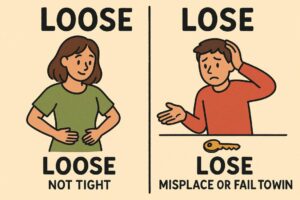
5. Loose vs. Lose
People often mix up loose and lose because they look so similar, but they mean totally different things. Loose (with two o’s) is usually an adjective and describes something that isn’t tight or is free. For example: My shoes are loose or She wore a loose dress. On the other hand, lose (with one o) is a verb and means to misplace something or fail to win. For example: Don’t lose your keys or Our team will not lose this game.